
Guides
Protective Gloves Selection Guide
This protective glove selection guide helps you identify the right gloves for your specific needs or those of your workforce.
How to choose the right protective gloves
Our guide helps you find the glove that best matches your work. If you need expert advice on glove selection or use, our specialists are here to help. Always follow the PPE guidelines and regulations applicable to your workplace.
The glove must feel right on the hand
A quality protective glove must be comfortable to wear. A well-fitting glove is also typically more durable and less likely to cause friction-related irritation. A properly fitting glove is easy and effortless to use.
Always check for the CE marking and the identification number of the notified body that granted the certification.
Base your selection on a risk assessment
Gloves must be selected in accordance with the work task and the risk assessment derived from it. The risk assessment should identify the hazards to which workers’ hands are exposed — including mechanical, chemical, thermal (heat and cold) and biological factors — as well as the nature, duration and frequency of exposure at each workstation.
What size protective glove should you choose?
The glove must fit correctly. An oversized glove can impair grip and may slip off the hand entirely. Conversely, an undersized glove may constrict the hand, and cold or heat protection properties may be compromised when the lining is pressed too tightly against the skin.
PVC-coated protective gloves have a generous fit, so this should be taken into account when selecting a Jokasafe glove. In many cases, one size smaller than your usual size will be sufficient. If you wear Jokasafe protective gloves for extended periods, thin cotton or polyester glove liners worn underneath can help reduce perspiration and improve wearing comfort.
Glove sizes are indicated by numbers or letters. There are some variations between sizing systems, but the most common equivalencies are shown in the sizing table.
Glove sizing comparison table
| Letter sizing | Number sizing |
|---|---|
| XS | 6 |
| S | 7 |
| M | 8 |
| L | 9 |
| XL | 10 |
| XXL | 11 |
CE CATEGORIES
The CE category of a protective glove (CAT I–III) indicates its level of protection.
Gloves protecting against minor, easily identifiable risks where the user can assess and anticipate the hazard in good time.
Typical protection:
- Surface soiling, dust
- Contamination
- Surface heat up to approx. 50°C
- Minor mechanical hazards (superficial scratches, light abrasion)
- Domestic and gardening tasks
Conformity assessment: manufacturer’s own quality control is sufficient (no notified body required). Example: thin disposable glove, lightweight gardening glove.
Gloves protecting against risks that are neither minimal nor life-threatening. This category covers the majority of industrial, construction and mechanical work gloves.
Typical protection:
- Mechanical risks (EN 388)
- Abrasion
- Cut
- Tear
- Puncture
- Moderate heat or cold resistance (non-extreme)
- General industrial and workplace hazards
Conformity assessment: EU-type examination by a notified body, which issues a type-examination certificate. Example: work gloves, mechanical protective gloves, light welding gloves.
Gloves protecting against severe or life-threatening hazards where the user cannot detect the risk in time without adequate protection.
Typical protection:
- Chemicals (EN ISO 374-1)
- Micro-organisms / biological hazards (EN 374-5)
- Intense heat / flame (EN 407)
- Electric arc
- Very high mechanical protection (e.g. cut resistance level F)
Conformity assessment: EU-type examination + ongoing quality surveillance (audited by a notified body). Example: chemical protective gloves, flame-resistant gloves, heavy industrial gloves.
EU STANDARDS
EU standards for protective gloves ensure that gloves provide the required level of protection against specific hazards. Key standards are listed below.

Performance level markings:
- Abrasion resistance, levels 1–4
- Cut resistance (COUP test), levels 1–5
- Tear resistance, levels 1–4
- Puncture resistance, levels 1–4
- Cut resistance (TDM test), levels A–F
- Impact protection, pass/fail P (marked only if requirement is met)
X = property not tested 0 = performance level does not meet minimum requirement
Cut resistance may be tested using two methods. The TDM test and its performance marking are used primarily for high cut-resistance gloves.

Chemical protection markings
Chemical protective gloves are classified into three types:
Type A — protection against at least six test chemicals for a minimum of 30 minutes (performance level 2) Type B — protection against at least three test chemicals for a minimum of 30 minutes (performance level 2) Type C — protection against at least one test chemical for a minimum of 10 minutes (performance level 1)
The third line of the Type A and B pictogram indicates which chemicals the glove protects against, as shown in the table below. The Type C pictogram does not include a third line.

This standard measures the ability of a protective glove to protect the user against micro-organisms, including bacteria, fungi and viruses. Gloves must be impermeable in accordance with the same test methods as chemical protective gloves.

Performance level markings:
- Convective cold, levels 0–4
- Contact cold, levels 0–4
- Water penetration, level 0 (no penetration) or 1 (penetration)

Performance level markings:
- Burning behaviour
- Contact heat
- Convective heat
- Radiant heat
- Small molten metal splashes
- Large molten metal splashes
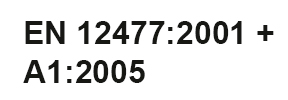
Specifies requirements for gloves used in welding applications. Type A — heavier gloves with superior protection compared to Type B Type B — gloves for tasks requiring manual dexterity, such as TIG welding.

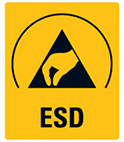
Electrostatic dissipative gloves minimise explosion risk and must be used in conjunction with grounded footwear. Gloves alone do not provide complete protection. Used in ESD-protected areas.
Symbols


EN standard test chemicals and CAS numbers
The CAS number (Chemical Abstracts Service) is the internationally recognised identifier for chemical substances. The EN standard covers only a subset of all chemicals. Each standard chemical is assigned a letter code (A–T), which is also indicated on the glove’s chemical protection classification. Gloves may also be tested against chemicals outside the standard, in which case the glove manufacturer or certification holder discloses this information independently. Jokasafe has tested and classified its smooth-coated protective gloves against three chemicals not covered by the EN standard and discloses these results in its chemical resistance table below.
| Code | Chemical | CAS No. | Category |
|---|---|---|---|
| A | Methanol | 67-56-1 | Alcohol |
| B | Acetone | 67-64-1 | Ketone |
| C | Acetonitrile | 75-05-8 | Nitrile compound |
| D | Dichloromethane | 75-09-2 | Chlorinated paraffin |
| E | Carbon disulphide | 75-15-0 | Sulphur-containing organic compound |
| F | Toluene | 108-88-3 | Aromatic hydrocarbon |
| G | Diethylamine | 109-89-7 | Amine |
| H | Tetrahydrofuran | 109-99-9 | Heterocyclic ether compound |
| I | Ethyl acetate | 141-78-6 | Ester |
| J | n-Heptane | 142-85-5 | Saturated hydrocarbon |
| K | Sodium hydroxide 40% | 1310-73-2 | Inorganic base |
| L | Sulphuric acid 96% | 7664-93-9 | Inorganic mineral acid |
| M | Nitric acid 65% | 7697-37-2 | Mineral acid |
| N | Acetic acid 99% | 64-19-7 | Carboxylic acid |
| O | Ammonium hydroxide 25% | 7664-41-7 | Inorganic gas |
| P | Hydrogen peroxide 30% | 7722-84-1 | General chemical reagent |
| S | Hydrofluoric acid 40% | 7664-39-3 | Inorganic acid |
| T | Formaldehyde 37% | 50-00-0 | Organic gas, aldehyde |
Chemical permeation performance levels
During testing in accordance with the chemical classification standard, the glove is exposed to the test chemical and assigned a performance level based on the breakthrough time. The longer the breakthrough time, the higher the performance level — and the greater the glove’s protective capability against that chemical.
| Permeation time | Performance level |
|---|---|
| > 10 min | 1 |
| > 30 min | 2 |
| > 60 min | 3 |
| > 120 min | 4 |
| > 240 min | 5 |
| > 480 min | 6 |
Jokasafe protective glove chemical resistance classifications
| Chemical test EN ISO 374-1:2016 EN ISO 374-5:2016 | Glove type: granulated coating | Glove type: smooth coating | |||
| Tested chemicals and applications | CAS N:o | Performance level | Min. permeation time (min) | Performance level | Min. permeation time (min) |
| K — Sodium hydroxide 40%, NaOH (caustic soda / lye) Applications: paper industry; pharmaceutical manufacturing; detergents; drain cleaning agents | 1310-73-2 | 6 | 480 | 6 | 480 |
| L — Sulphuric acid 96%, H₂SO₄ (oil of vitriol) Applications: fertiliser production; manufacture of dyes, pharmaceuticals and explosives; oil refining; battery acid | 7664-93-9 | 2 | 30 | 3 | 60 |
| M — Nitric acid 65%, HNO₃ (saltpetre acid) Applications: fertiliser production; manufacture of dyes, pharmaceuticals and explosives; synthetic fibre production | 7697-37-2 | 3 | 60 | 3 | 60 |
| P — Hydrogen peroxide 30%, H₂O₂ Applications: bleaching agent for pulp and textiles; disinfectant in pharmaceutical and food industries; cosmetics | 7722-84-1 | 6 | 480 | 6 | 480 |
| S — Hydrofluoric acid 40%, HF (hydrogen fluoride) Applications: oil refining; glass and steel manufacturing; aluminium production | 7664-39-3 | 6 | 480 | 5 | 240 |
| T — Formaldehyde 37%, CH₂O (methanal) Käyttö: Applications: resin and mineral wool production; textile and cosmetic product manufacturing; adhesives, cellulose and explosive manufacturing | 50-00-0 | 6 | 480 | 6 | 480 |
| White spirit 100 %, solvent naphtha (petroleum), medium aliphatic | 64742-88-7 | – | – | 4 | 120 |
| Formic acid 76% | 64-18-6 | – | – | 4 | 120 |
| Hydrochloric acid 37% | 7647-01-0 | – | – | 5 | 240 |
| Phenol 80% | 108-95-2 | – | – | 3 | 60 |
Need more information?
Contact our glove specialists.